
Sao Tome e Principe works with technology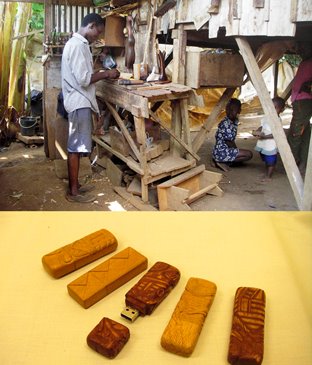
I know, I know - enough USB stuff already, but this is a little different:
Sao Tome e Principe is a West African country with a population of about 150.000, located on the Guinea Gulf along the Equator. SEED 2006, a Design and Social Economy project financially supported by the Portuguese Cooperation and developed by designer Pedro Alegria, introduced USB flash card design to local craftsmen, all of whom had never seen or heard of such things before. The end result merges traditional "forgotten" craft with hot technology on the rise, sustaining the working families' needs and offering unique craft-designs to the masses.
The project is currently seeking large orders to maintain and increase production.
VIA.
Sunday, July 16, 2006
Sao Tome e Principe works with technology

Sunday, July 09, 2006
Keyboard Food Tray Prototype, Genius
Keyboard Food Tray Prototype, Genius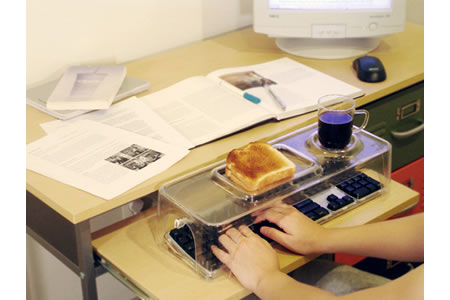
Many of us spend a lot of time working on the computer and sometimes we even have our meals while working. Due to the office supplies there is not enough space for food on the desk. Here is an ingenious design which makes use of the keyboard which occupies the max space on the desk. A food tray which fits on the keyboard and allows you to have food without any work interruptions.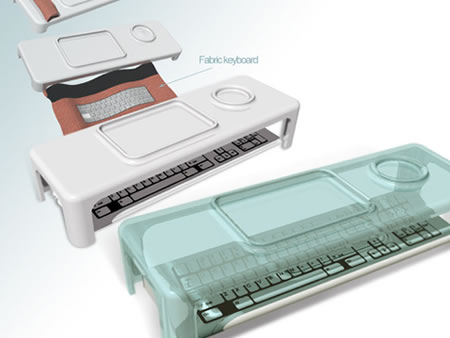
The Keyboard tray is designed by Duck Young Kong and is still to enter into production.
Source
Wednesday, May 24, 2006
How to run your own internet radio station
How to run your own internet radio station
If you've ever wondered how internet radio stations work and/or wanted to create your own, this tutorial will show you how. It is actually very easy, and you can set up your own radio station and begin broadcasting songs in about 10 minutes.
First of all, let me give you a quick rundown on how it works. You have your music player (I will use Winamp, get it if you don't have it) and you play your music as you normally would. Through a plugin (which you will download and install), Winamp will send the music you play to the broadcasting server (which can be on your PC or on another one with a larger connection), and the server sends the music to the listeners, reencoding it to a better format, if you are so inclined. Note that the amount of listeners you will be able to support is limited by your outgoing bandwidth and the bitrate of the song you are streaming, so if you're streaming at 128 kbps and you have 256 kbps upload bandwidth, you'll obviously be able to support 256/128 = 2 listeners.
The programs I use are Winamp for playing, oddcast DSP for broadcasting to the server and Icecast for serving. You can use Winamp's own Shoutcast plugin and server, but I prefer to broadcast in Vorbis because it's smaller and has much better quality than MP3.
Let's get started, then. Download Icecast from this page (you presumably want the Windows version) and install it. Run it and click "Edit configuration" in the "Configuration" menu. A notepad window will pop up with various configuration options. My configuration is this:
You can copy it and paste it in your file, but make sure you change "hackme" to more secure passwords. Once you have done this, save the file and close the window. Click the "Start server" button and the listboxes below should be populated with various information, like this: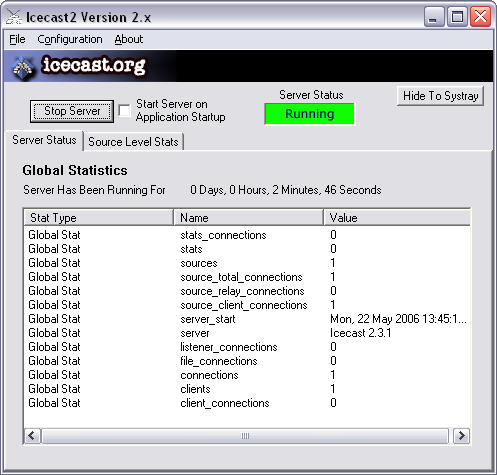
Your server is now ready for people to connect to it, but there's no music playing, so let's tend to that. Download oddcast for Winamp from this page and install it. Now, run Winamp, go to the "DSP/Effect" section of the preferences and click on "oddcast DSP v3". You should see the oddcast window pop up, looking something like this:
Click on "Add encoder" and a new encoder will be added in the box below. Right-click on it and select "configure". A dialog will pop up, asking for various information. For "Encoder type" select "OggVorbis" (or MP3, if you are so inclined), this will make you stream in Vorbis. Some people might not be able to have the available codecs if they're running a very old version of their player (all newer players worth their salt support Vorbis).
For "Quality" I have entered -2, it is the lowest quality, giving you about 30 kbps bitrate and very acceptable quality. You can experiment with 0 or 2, going over 6 is overkill in my opinion (since 6 is what I use to archive music from my CDs), and you will be able to support more listeners if you have lower bitrate for the song.
For "Server IP" enter the IP of the server you're running Icecast on (it's "localhost" if you're running it on your own PC). "Server port" is whatever you entered in the configuration, 8000 if you used mine, and "Encoder password" is hopefully something other than "hackme". I also use mono, because my connection only has 128 available upstream bandwidth and it doesn't sound too bad.
Click OK here and then click "Connect". If you did everything right, the encoder should now connect to Icecast and begin streaming, like so: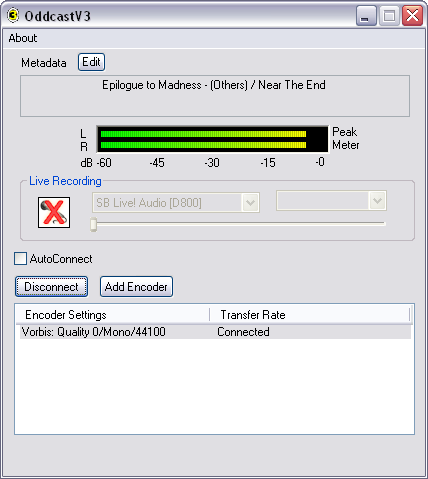
If you want to do a voiceover (speak in your radio) just click the Live Recording button and it will broadcast anything that you say in the microphone (or whatever you enter as the input device). Click on it again to return to your normal music (I haven't actually tested this, if there are any problems just comment here).
The "Source Level Stats" section of Icecast should also change to include your stream, and will look something like this:
You can now tell people to connect to http://[yourip]:8000/stream.ogg with their players, and that's all there was to it. Happy DJing.
Note: Before you broadcast any music, make sure you have the right to do so, otherwise you could be breaking the law of your country.
[VIA]:Poromenos
Tuesday, May 09, 2006
Flying suicide bomber drones could be almost unstoppable

Flying suicide bomber drones could be almost unstoppable
If you thought the 12-gauge shotgun-wielding AutoCopter was bad news, imagine one of the little menaces in the hands of a terrorist and strapped with several pounds of explosives -- or worse, biological, chemical, or radiological payloads. Several experts are warning that we are nearly defenseless against such attacks, even though terrorists have already shown a propensity for using such tactics in the Middle East and South America, and are known to have purchased so-called "drone" airplanes capable of high-precision navigation even over long distances. One scenario that is particularly disturbing involves a fleet of drones or robotic helicopters launched from an off-shore freighter, sent en masse to attack a large gathering like a sporting event where stampeding from panic would likely cause more deaths than the bombs themselves. The Pentagon is supposedly working on an drone-killing drone of its own, called Peregrine, that would patrol the skies and intercept any hostile aircraft -- but the main problem seems to be finding, not destroying these things, and you'd need a whole lot of Peregrines to cover every potential target in the US.[Via Phys Org]
Monday, May 08, 2006
Neptus 60 Cliff Habitat
Neptus 60 Cliff Habitat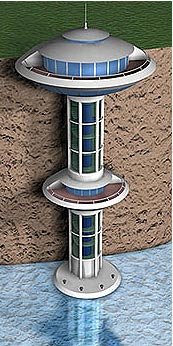
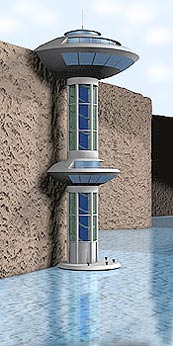
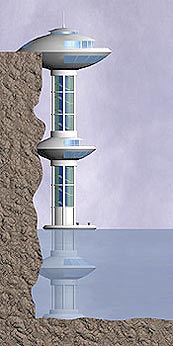
Neptus 60 is a Cliff-House designed by Naval Architect Giancarlo Zema and exclusive to Underwater Vehicles Inc. Neptus 60 has been conceived to create a cliff side environment in harmony with nature. It allows the occupant to fully enjoy the cliff placing, to admire the views on the sea and the spectacular underwater sea life. The project reflects on Neptus, the amphibious shellfish that once thrived in the oceans over 500 million years ago. Neptus 60 is made up of 4 elements: (1) living area (2) observation deck, (3) docking for boats, (4) underwater observation globe
The different floors are connected with a winding staircase that looks on the sea, and served by a glass elevator.
(1) Living area - Circular construction anchored on the cliff. It is divided in a living room with terrace and a night area with 3 bedrooms looking on the sea with inclusive ensuite bathrooms.
(2) Observation deck - Capsular layout hanging at 20m on the sea level. It allows you to look at the sea in a comfortable and private place.
(3) Docking for small craft - A wharf allows you to reach Neptus 60 directly from the sea.
(4) Underwater observation globe - The most interesting space complete with underwater lighting and diver lock-out options. Underwater components by renowned submarine manufacturer.
Technical characteristics
Carrying structure - that can be modulated, that can be anchored on every sort of cliff.Living area - diameter 18m, 250 square meters on two levels.Observation deck - 80 square meters on 2 levels.Wharf - 40 square meters.Underwater observation globe - 80 square meters om 2 levels completely underwater.Elevator lift capacity - 650 kg (6 people), speed 1.5 m/s, height 50 mt.
Thursday, April 27, 2006
Future Flying in Hamburg
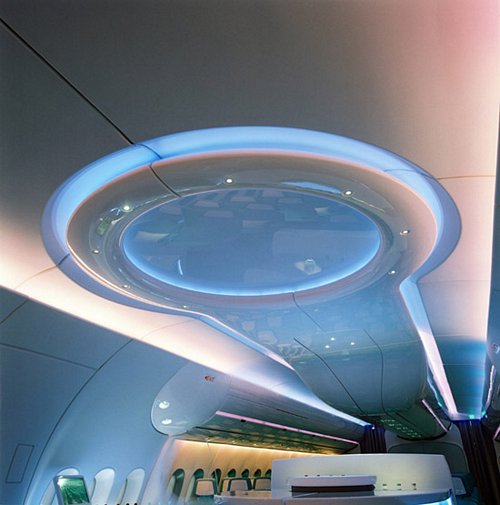
Future Flying in Hamburg One of the biggest highlights of the show was the unveiling of the new cabin area for the Airbus a350. At a minidesk in the business corner, a passenger can get the same connectivity as on the ground.
The Airbus a350 will be able to seat more than 300 passengers in three levels when it takes off in 2010.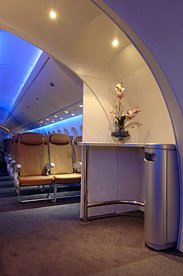
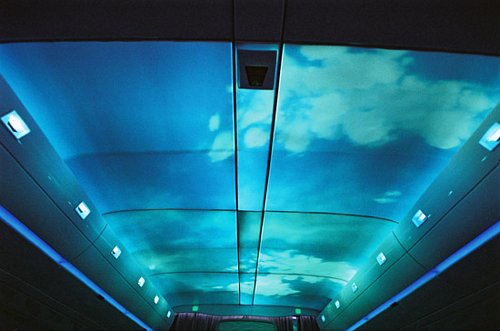
Airlines showed off their new passenger comforts at the Airline Interior Expo held in Hamburg, Germany, earlier this month.
The Airbus a350 will already have a competitor, the Boeing 787 Dreamliner, due in 2007. It will feature an on-board wireless in-flight entertainment system with a new configuration designed to reduce weight and let passengers easily conduct business and access entertainment while in flight. Windows on the Dreamliner will also be larger.
OnAir announced that it plans to release a GSM network for aircraft that will allow passengers to use their own mobile phones to send and receive calls and text messages.
TAP and Air France has signed up for the service which is scheduled to begin operations in 2007. OnAir is a joint venture of Sita Inc. and Airbus. Read the complete story here.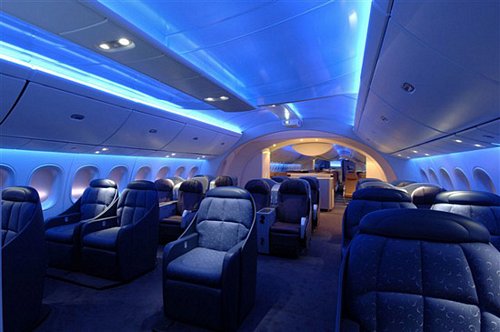


Monday, April 24, 2006
Hula Chair
Hula Chair
Hula Chair
The Hula Chair. No prizes for guessing what this puppy does. Yep, it hulas. [Er is that a verb? – Ed]. The idea seems to be that an auto-gyratory motion can be healthy. Mmm… $199.95.
This modern miracle combines the best of ancient traditional Chinese medicine with 21st century space-age technology. Improve your balance and coordination as it gently aligns your spine and improves blood circulation. You’ll love how it feels as it works out your abs and mid-section. And there’s no better way to warm up for any activity. You’ll never experience a more pleasurable workout! Simply sit upright in the Hula Chair, press the button and let its elliptical motion work wonders on your body.
Thursday, April 13, 2006
Samsung claims the world’s thinnest phone
Samsung claims the world’s thinnest phone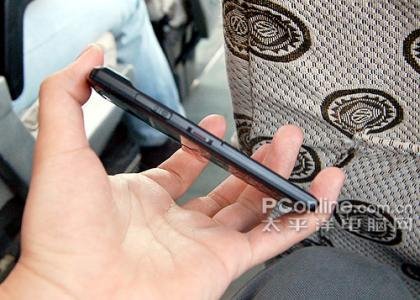
Samsung have announced what they claim is the world's thinnest mobile phone. The Samsung X828 beats the previous record-holder, the KTF EV-K100 (itself announced only two weeks ago!) by a full millimeter. One millimeter may not sound much, but given that the EV-K100 was only 7.9mm, the new Samsung X828's record-breaking 6.9mm is a full 12.7% thinner.
At these levels of thinness, that's a quantum leap! Even more amazing, it's half the size of Motorola's RAZR V3 (13.9mm), yet still packs a 2 megapixel camera, MP3 player and 80MB of memory! Stunning!
More pictures and details of Samsung's world's thinnest phone after the jump.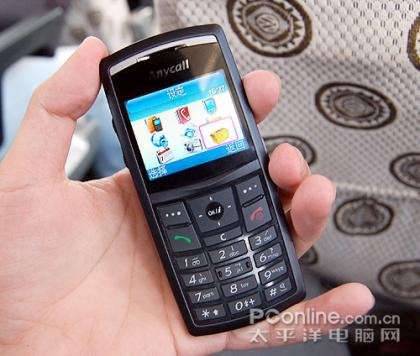
Motorola started the trend for thin phones with the launch of the Motorola RAZR V3 back in 2004. At 13.9mm, the RAZR stunned the world and still sells in huge volumes today. However, the original V3 only had a VGA camera, whilst newer variants, such as the Motorola V3c, which come with a 2 megapixel camera, have bloated to a whopping 23mm.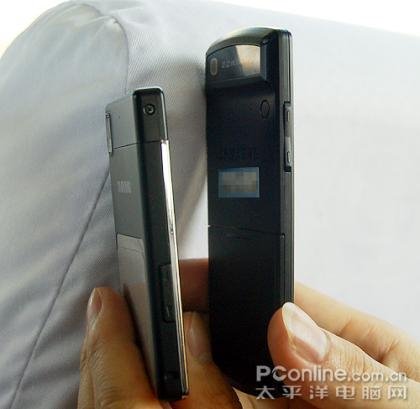
Pundits have been wondering whether the RAZR is the only phone Motorola can sell, as all their recent releases have just been different variants (or colours) of the same thing. Now Samsung have thrown down the gauntlet big time. They've shown a slim phone doesn't have to be short on features, and that 13.9mm just isn't slim enough any more. Ball's in your court now, Motorola!
[Source: PCOnline, via HipTechblog]
Monday, April 03, 2006
An Interactive LED Dining Table
An Interactive LED Dining Table
Type: Maker Table Top Exhibits
We made a dining table with a frosted glass top lit by 448 multicolored LEDs that respond, in a complex and gentle fashion, to input generated by motion above the table while we eat.The LEDs are controlled by a 16-node 1-D analog computer network. Each node has an amplified photodiode that senses changes in ambient light above its region of the table. An analog integrator (memory) averages that signal along with input from its neighbors, and the resulting signal is used to drive one of two strands of 14 LEDs (depending on polarity) with intensity that depends on the integrated value. Each node consists of one photodiode, one quad op-amp IC, nine resistors, and four capacitors that we hand-soldered onto a tiny piece of plain perfboard. We mounted the nodes to sheets of masonite pegboard, such that the output LEDs fit through the holes. After (a dozen or so evenings of) soldering, the pegboard with its electronics and a power supply was set into a stained-wood table frame that we made out of birch and poplar, and topped with glass recycled from a desk top.We'll bring the table itself and have it running at (as) our table. We'll also bring a miniature version of the table electronics-- a four-node network-- for demonstration, the circuit diagram, and a couple pictures of the build process.
Related site: http://windell.oskay.net/Table2_Med.mov
Presenters
Windell H. Oskay,Lenore M. Edman,Christian W. Brookfield
The Data Glove
The Data Glove
The 5D Data Glove. Of absolutely no use whatsoever to anyone unless hooked up to a motion capture system, but still….there’s something fashionably chic about it, don’t you think? In a ‘not quite Michael Jackson’ way. USB or wireless Bluetooth versions available from just $995.00. Bargain!
The system interfaces with the computer via a USB cable. A Serial Port (RS 232 - platform independent) option is availible through the 5DT Data Glove Ultra Serial Interface Kit. It features 8-bit flexure resolution, extreme comfort, low drift and an open architecture. The 5DT Data Glove Ultra Wireless Kit interfaces with the computer via Bluetooth technology (up to 20m distance) for high speed connectivity for up to 8 hours on a single battery.
Friday, March 24, 2006
DIY Toilet Paper Cannon.
DIY Toilet Paper Cannon.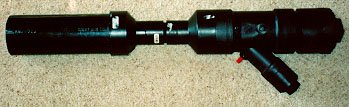
The DIY Toilet Paper Cannon. Er…apparently there is a significant market in the world for building your own air powered gun for shooting…ah…full rolls of toilet paper into trees. You couldn’t make this stuff up, could you? Could you? Ah well. So the plans for this poop puppy…sorry…will set you back a rock bottom…oops…price of $10.61. Oy yoy yoy!
TP is very fun to launch. You can launch a whole roll of toilet paper and watch it un-roll through the air (be careful, the TP can catch on fire). This is good for TP’n someone’s house, yard, trees, the whole block! Any cannon can be used to shoot toilet paper. It just requires the cannon to have a 14″ long 4″ wide barrel. You will also need wadding when shooting TP.
Wednesday, March 22, 2006
The Rowbike.
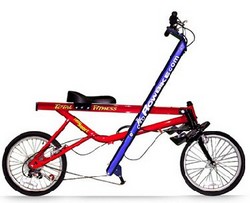 The Rowbike.
The Rowbike. Get fit while commuting? Hmm…maybe. From the inventor of the rollerblade, which probably says all that needs to be said, doesn’t it? From $599.00. [Via transporttrends].
Rowbike is a revolutionary new fitness machine that blends all the freedom of a bicycle with the ultimate fitness and health benefits of rowing machines! With the Rowbike, you can work your body out while enjoying the wind in your face and the sun on your back! It takes you and your fitness to a whole new level . . . while it takes you to the places you want to go.
Thursday, March 16, 2006
Motorized Pool Lounger
Motorized Pool Lounger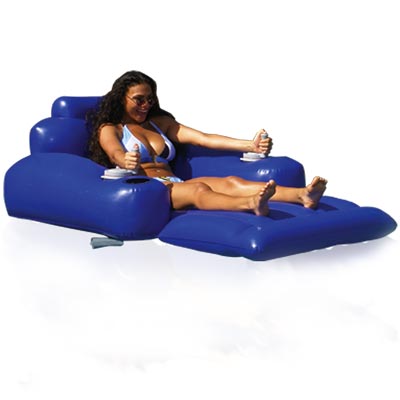
Motorized Pool Lounger. OK, correct me if I’m wrong, but isn’t the point of a pool *lounger* to…ahem…lounge? Technically this should be called a Motorized Pool Annoyer, shouldn’t it? Yeah well, it’s $149.95 (not including third party liability insurance we presume).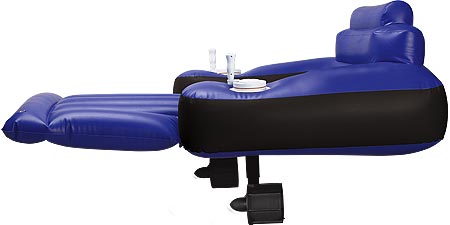
The Motorized Pool Lounger may be the most advanced pool lounger in the world—and it’s definitely the most fun! Two quiet but powerful motors will propel you around your pool in comfort and style, with easy-to-use joysticks that control two independent propellers. Why just float when you can drive?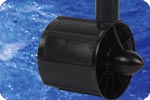
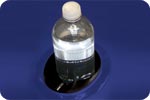

- Large, comfortable armrests
- Independent power and directional control
- Built-in cup holder
- Supports up to 250 pounds!
- Two separate motor/propeller subassemblies
- Sturdy 0.35 mm PVC construction
- Requires 12 x 1.5 volt D-Cell batteries (not included)
Sunday, March 12, 2006
Samsung shows off flash laptop drive at CeBIT
Samsung shows off flash laptop drive at CeBIT
That long-dreamed-of product, the solid-state laptop, is one step closer to reality, as Samsung is showing off a flash-powered laptop at CeBIT. The demo box uses a 32GB 1.8-inch solid-state drive created by Samsung, to show off the company's flash chops. Unfortunately, at $30 per gigabyte, the 32GB drive would cost over $900. However, with flash prices continuing to decline, and companies like Intel predicting that flash laptops are on their way, we may not have to wait too much longer for this to be feasible -- though, even at over $900, that flash laptop drive sounds mighty tempting.
[VIA Engadget]
Saturday, March 11, 2006
These Dada Sneakers Were Made For...Music

These Dada Sneakers Were Made For...Music
Move over Oakley Thump MP3 sunglasses. There's a new wearable MP3 system to stomp the competition.
Dada Footwear is launching a wireless footwear system dubbed, "Code M." The Code M System delivers both audio and data—through your sneakers! Say goodbye to wires and carrying an MP3 player.
The Code M System is integrated into the basketball sneaker's heel and tongue. It can hold up to 100 songs, running on a 6-hour battery life. To transfer songs onto the system, just use the USB port on the side of the shoe. To listen to your music, use the included wireless headset, which picks up the music playing from your sneakers up to 30 feet away.
Here comes the real kicker: the sneakers will also feature house speakers for listening to music out loud. (I can just imagine Michael Jordan being the spokesperson.)
If the Code M Sneakers prove successful, the company plans on expanding their line to a Get-Fit program in which you can receive workout-related data from a personal trainer's voice. It doesn't end there. The shoes may also be designed as a way to forward your phone calls to it.
I think this is a really cool idea, although I hope they're sweat-proof out on the court. I don't know how well the sound quality will be, but Dada certainly knows how to think out of the box. Hopefully they'll come out with other colors.
The Code M Sneakers will sell for $199.99 beginning in April 2006.
[via TechEBlog]



Friday, March 10, 2006
Live from CeBIT: Samsung's SCH-B600 10 megapixel cameraphone
Live from CeBIT: Samsung's SCH-B600 10 megapixel cameraphone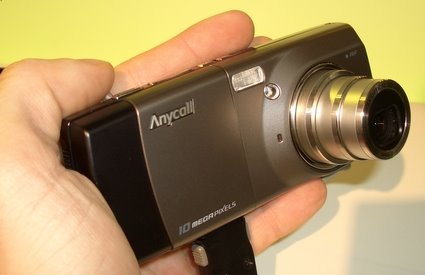
Ever hold a ten megapixel cameraphone? Naw, neither had we, not until today anyway. Straight from the floor at CeBIT, we've got the Samsung SCH-B600 with an integrated 10 megapixel shooter. It's never gonna come anywhere close to the US or Europe so nuzzle up to your monitor real close-like and take in this beauty. Click on for more pics.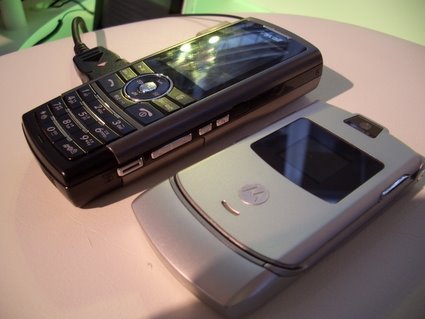
At least they can't brag about it being RAZR thin -- still, not bad.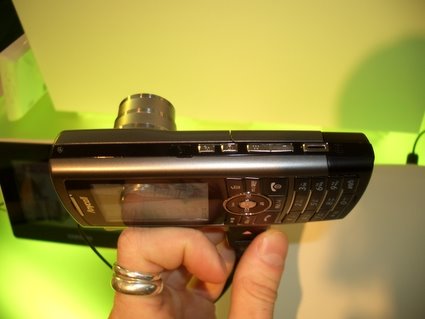
Camera controls right up top where you'd expect 'em.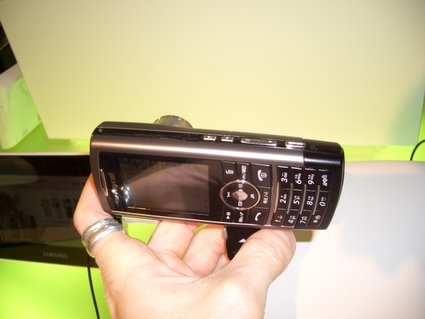
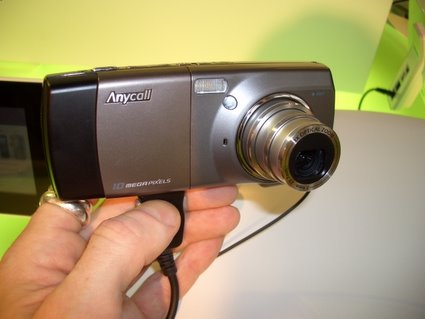
Wednesday, March 08, 2006
Tree-climbing robot

Tree-climbing robot
A remarkable, if slightly creepy, tree-climbing robot is being developed by robotics experts from Carnegie Mellon and several other US Universities. And here's a video of it scrabbling up several different surfaces.The aim of RiSE (Robots in Scansorial Environments) is to develop a robot capable of walking on land and also crawling up vertical surfaces. And it is funded by DARPA's Biodynotics Biologically Inspired Multifunctional Dynamic Robotics (BIODYNOTICS) Program.Obviously such a robots could have plenty of useful applications, in search-and-rescue and space exploration, for example. But presumably it could also help you reach those really hard-to-prune branches.


Monday, March 06, 2006
The Toilet Guitar..
The Toilet Guitar..
The Toilet Seat Guitar. Complete with toilet paper strap. Apparently it has a very good bottom end. Boom, boom. Thank yew, we’ll be here all week, folks.
Okay, I don't think this one needs much narration. This little gem was brought to our attention by our pal Andy way over there in Canada (Hi Andy! *waves*), and although it isn't a bass, I nonetheless felt compelled to share this work of art with you. It is, in my opinion, the very definition of amusing. I especially appreciate the attention to detail - the toilet-appropriate hardware, the toilet paper strap (which actually looks pretty comfy to me), the realistic turd (I almost used the phrase 'life-like'! Yikes!) pick-up mount. Andy tells me that a bass version is available - I know a certain bass player out there who can hardly contain himself (no pun intended). Right, Keith?


