
Turn and old scanner into a 115 megapixel camera (sample photos)
Building homemade digital cameras from low-end flatbed scanners.
Making new kinds of cameras to see the world in a new way...
Several years ago, I built my first homemade digital camera. The idea was simple - I would take an ordinary flatbed scanner, and use it in place of photo paper with a large format camera.
My first scanner camera was made from lots of duct tape, a cardboard box, and the cheapest flatbed scanner that I could find. I expected this to be a quick little art project, one that would take a week or two at the most. But when I got my first homemade digital camera to work, I noticed that some wonderful things were beginning to happen.
The objects in the scene that were stationary photographed normally, while the objects that were moving were twisted and distorted into wonderful shapes. At first, I thought that this was a mistake, that something was wrong with my new contraption. But I soon realized that the motion of the scanner was meshing with the motion of the recorded scene, creating unexpected, yet predictable, results. These motion distortions are similar to the effect created by moving a sheet on a photocopier mid-copy, except that they extend into three dimensions and only effect objects in motion.
I was tremendously excited by these developments. Instead of building a camera that mimicked the functionality of a traditional photographic camera, I had stumbled across a new tool for examining the relationships between time, motion, and image. What I though would be a two week art project has turned into one that has lasted for almost three years, and shows little sign of stopping. My cameras work a lot better now, although most of them still use a lot of duct tape, cardboard, and cheap flatbed scanners. I've begun to learn the vocabulary of the scanner camera, begun to be able to interpret and previsualize these strange new pictures. Some aspects of scanner photography are similar to traditional photography, and others are completely foreign.
Thanks for looking at my work... I hope you like it!
Mike Golembewski
P.S. Here's a little information about these photographs. The only software based manipulation of any of these images has been some slight adjustments of the curves and levels, in order to improve contrast and tone for print and screen display. They haven't been 'Photoshopped' in order to create these effects. All of the motion distortions are created entirely in camera.
© 2002-06 Michael Golembewski. Sponsored by the Audi Design Foundation, 2004-05. email
Most recent scanner camera...
The scanner camera that I'm using right now uses the frame of an old Horseman 450L monorail 4x5 camera, which I purchased secondhand with the support of the Audi Design Foundation. The scanning back is an extensively modified Canon LIDE 20, from which I have reomved the lamp, pinhole lens assembly, and CIS sensor housing. I've made the scanner light-tight using duct tape and putty, covered with a hefty dose of black spraypaint. It might look crude, but it works very nicely. I've attached a modified lens board directly onto the scanner, so it can easily be connected to the Horseman. The lens board attachment holds the scanner optics at the same level as a ground glass plate. This allows me to compose and focus shots on the ground glass, instead of with preview scans - it's much faster. I have two lenses that I use with this model - a Kompur lens from 1915, and a found 8x10 enlarger lens.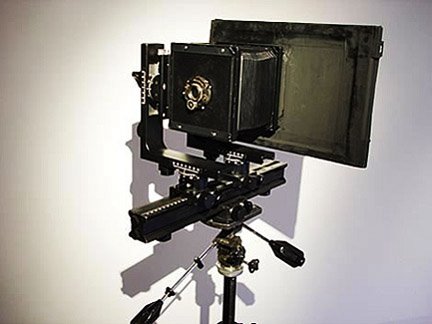
Here are a few technical specifications for this camera... I'll add a few more later on (once I get around to gathering the data...)
Maximum resolution:115,200,000 pixels per image (over 115 megapixels).
Scanning speed: 15 seconds to five minutes scan time, depending on resolution.
© 2002-06 Michael Golembewski. Sponsored by the Audi Design Foundation, 2004-05. email
Thursday, January 19, 2006
Turn and old scanner into a 115 megapixel camera (sample photos)

Tuesday, January 17, 2006
Hasselblad Introduces its New 39 Megapixel H2D-39 Digital Camera
Hasselblad Introduces its New 39 Megapixel H2D-39 Digital Camera
Hasselblad's new H2D-39 D-SLR is the first true 39 megapixel digital camera in the world. It is based on Hasselblad's existing H2 digital camera and is compatible with the company's H System lenses and V camera lenses.
The camera's CCD sensor is more than twice the size of conventional 35mm camera sensors (36.7 x 49.0 mm). At maximum resolution, the images captured by the H2D-39 in Hasselblad's proprietary 3F RAW format are 78MB large (50MB with lossless compression).The camera features a 2.2? OLED display, a FireWire 800 interface, support for CF media and an optional Image Bank 80GB external hard drive. The H2D-39 is also expandable thanks to its i-Adapter interchangeable camera interface. The CF-39, CF-39MS and CFH-39 digital-back modules allow the user to tailor the camera to his or her shooting parameters. Also featured is the company's digital APO correction (DAC) which diminishes the effects of color abberations and provides a fuller, more life-like picture. The camera captures images in 16-bit formats and supports ISO ranges 50, 100, 200 and 400. More details can be found HERE Preliminary pricing for the different digital-backs are as follows (in US dollars): H2D-39 - $ 32,000 CF-39 - $ 33,000 CFH-39 - $ 33,000 CF-39MS - $ 40,000
Source : dailytech.com
Monday, January 02, 2006
First jet powered Birdman flight
First jet powered Birdman flight
By Jezz Santos
Tuesday 25th October 2005 - It was an untypical crisp October morning in Lahti, Finland when Visa Parviainen and the BirdMan Rocket Team attempted to make the first ever jet powered, birdman flight.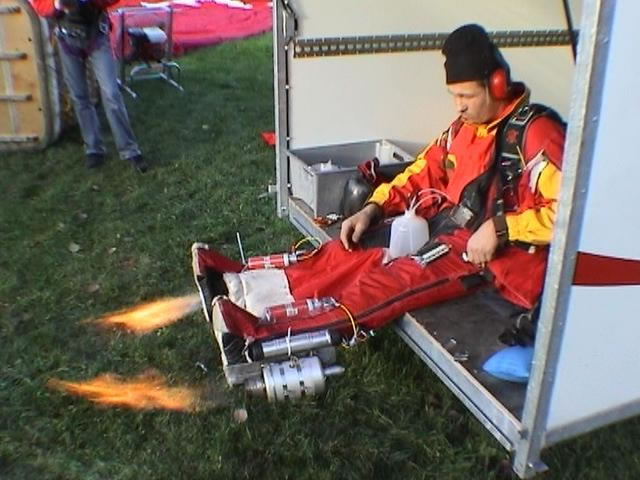
The team set up camp in a small park in downtown Lahti, to prepare for the jump. The locals appeared to be not-at-all phased by the fact that some person was igniting a jet engine in their tranquil little park while they were walking their house pets. The launch platform selected for the day was provided by the famous Finnish Balloon Bros, who graciously offered their services for this historic event. Visa had designed a unique launch platform to hang outside the balloon to avoid 'cooking' the balloon occupants during the ascent to altitude from the exhaust gases of the jet engines.
Once Visa had adorned his birdman suit and rig on the ground, it was time to test the rocket boots. Each jet engine provides around 16kgs of thrust, and is primed with a mix of butane and propane. Once ignited, the engines rely on a steady supply of kerosene (JetA1) fuel. This fuel burns at around the rate of 0.5 litres per minute, on full power, for each jet engine. The combined thrust of both power plants was calculated to be enough to sustain level human flight in a wing suit for an average weight skydiver.
Once all the gear checks were made and rigorous safety procedures executed on the ground, it was time to inflate the hot air balloon for the ascent. The Balloon Bros provided a smooth and relaxing ride up to altitude over the beautiful vista of the humble town of Lahti in middle Finland.
The Balloon ascended over the unpopulated areas around the lakes and forests of rural Lahti, visa primed and started the rockets prior to exit. After warming up the engines in the cold surrounding atmosphere, it was time to make the attempt.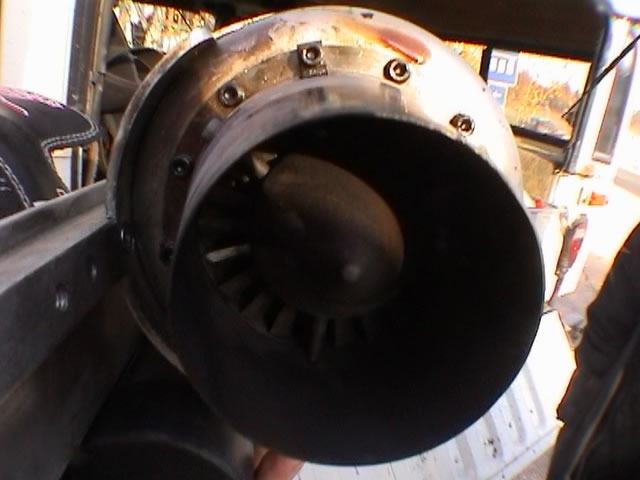
The high pitch whine of the jet engines sounded surreal in the calm stillness of the hot air balloon. Tensions were high that this attempt would be a successful one. It was time to go, as the fuel was rapidly running out, Visa gave the all clear sign (a quick grin) at around 2300m (7000ft) before 'edging' off the platform into the first rocket-powered-human-flight attempt.The exit was stable and on-heading, after attaining normal bird-man flight, Visa requested full power from the engines, which responded smoothly in horizontal acceleration. After checking the altimeter several times, it was apparent that there was no appreciable loss in altitude for this period of time. Visa next changed his angle of attack by redirected the thrust and changing his body position to attain vertical climb. This caused a loss in horizontal speed, and stalled (the body?). Recovering from the stall was made easy because of the agility of the human body to change flight profile easily. A few more attempts at this exercise yielded the same result. Pretty soon it became apparent that fuel consumption would soon terminate the level flight portion of the jump. Visa simply rode out the rest of the jump in level flight following the highway until the fuel ran out. Visa then continued in normal bird-man flight until deployment altitude. The deployment sequence was normal, and the landing was uneventful.
The jump has proven empirically that level human flight is possible and sustainable using the combination of jet engines and a bird-man suit. The strength required to control level flight was relatively easy, and controlling the direction of flight feels surprisingly natural. The duration of flight is simply a factor of the consumption of fuel of the engine(s) powering the flight.
Visa Parviainen has proven that with a little innovation, determination and courage it has been possible to realise the dream of uninhibited human flying
Video of the event
Sunday, January 01, 2006




Thursday, December 29, 2005
Stowaway Boomtube H201 Portable Speakers

Stowaway Boomtube H201 Portable Speakers
Boom Boom shake the room this New Year with the Stowaway Boomtube H201 Portable Speakers.
The Boomtube (also known as the Stowaway Boomtube H201 portable speaker system) is an ingenius speaker design produced by Think Outside. I like the rechargeable lithium-ion batteries that power it since buying normal cells are so troublesome.
When stored, it is shaped like an aluminum tube. Each end twists-off, and turns into portable speakers. It is designed to operate with many portable music sources, including personal MP3 players like iPods, Cellular MP3 phones, or even laptop computers.
Specific features include:
*Two-inch aluminum speakers for great sound and a subwoofer-like bass tube*40 watts of total system power.*Anodized aluminum housing resists stains and scratches.*Features rechargable Lithion-Ion batteries for up to 5 hours extended play.*Cellular MP3 Player phone ready; includes a 3.5mm to 2.5mm adapter*Combines four 2-inch drivers with dual neodymium magnets and MaxxBass technology.


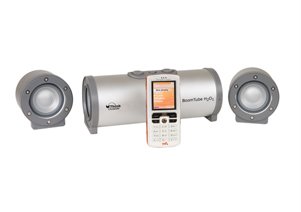
Stowaway Boomtube H201 Portable Speakers goes for USD $199.99 with Free Shipping until January 31st, 2005


