Giant mechanical O-nyudo doll
Each August in the city of Yokkaichi in Mie prefecture, a giant mechanical effigy of O-nyudo, a legendary Japanese monster, is paraded through the streets during the Grand Yokkaichi Festival. The mechanized puppet, said to be the largest karakuri ningyo in Japan, stands between 6.3 and 9 meters (20 to 30 feet) tall depending on how far its neck is extended. The giant O-nyudo wows spectators by swinging its arms, bobbing its head around on its long neck, moving its eyes and mouth, and sticking out its tongue as it is wheeled through the streets to the accompaniment of taiko drums.
Here’s a short video.
O-nyudo, whose name literally means “large monk,” appears in a number of folk tales across Japan. While his physical appearance and characteristics vary from story to story, he is always large, ranging anywhere from 2 meters (6 ft. 6 in.) tall to as large as a mountain. O-nyudo usually appears as a giant person or an indistinct shadow, though he is known to have the ability to shape-shift.
In most cases, O-nyudo is a malevolent figure that can cause people to fall ill simply by looking at them. Some stories identify him as being a fox or tanuki(raccoon dog) that has shape-shifted (a common ability for these animals in Japanese folklore), but in most stories, his true identity remains a mystery.
The Japanese Wikipedia entry for O-nyudo includes a nice selection of stories from different areas and time periods. Here are a few.
In Hokkaido during the Kaei period (c. 1850), native Ainu communities reported seeing O-nyudo near Lake Shikotsu and Mt. Fuppushidake. It is said that he could drive people to madness and cause them to lose consciousness just by looking at them with his large eyeballs.
In Toyama prefecture, people with medical conditions staying at the Kanetsuri hot springs to cure their diseases claim to have seen a 15- to 18-meter (50 to 60 feet) tall O-nyudo, who was described as being surrounded by a beautiful rainbow-colored halo.
In 1937 near Akabane station in Tokyo, a military officer delivering an akagami (draft card) had a frightening encounter with O-nyudo at a railroad crossing near Akabane-Hachiman Shrine. Here, O-nyudo appeared as a soldier. Four days later, the officer was hit by a train at the same railroad crossing. While stories rarely identify O-nyudo as a human spirit, this story suggests the O-nyudo was the vengeful ghost of either a new recruit that had committed suicide or a soldier that had been accused of failure and bludgeoned to death by a superior officer.
In some cases, O-nyudo is helpful. For instance, according to an old story in the town of Ishii in the Myozai district of Tokushima prefecture, an 8.5-meter (28 feet) tall O-nyudo would show up to help mill the rice whenever it accumulated at the local water mill. However, the O-nyudo only worked alone, and if anyone tried to observe him while he worked, he would turn angry and frighten them away.
Yokkaichi’s O-nyudo also appears to have been rather friendly, according to this website. One day long ago when Yokkaichi was a little merchant town, a large young man appeared at a small local shop and asked the owner to hire him. The shop owner, named Kyuroku, politely refused to employ the large man because the shop was too cramped to accommodate him. But the young man insisted, explaining to Kyuroku that he had just arrived from the countryside in search of work. Kyuroku eventually decided to hire him and gave him a room in his house behind the shop.
Mysteriously, the business began to thrive. Things went so well that after three years, Kyuroku asked the young man to marry his daughter so that he could one day inherit the shop. The young man refused the offer, saying he only wished to continue working as he had been.
Late one night the next summer, Kyuroku woke from his sleep and decided to step outside for some cool air. As he walked past the young man’s room, he noticed the glow of an oil lantern inside, visible through the shoji screen. The light cast a large shadow on the shoji that stopped Kyuroku dead in his tracks. He saw the ghastly, dark shape of a head attached to a long sinuous neck, slowly twisting and turning back and forth. Kyuroku watched in horror as the shadow snaked its head to the lantern and began to lick the oil. The head at the end of that horrible neck clearly belonged to the young man.
Kyuroku passed out from fear and fell to the floor. After waking the next morning, he cautiously went to the young man’s room and peeked inside. The room was empty except for the man’s striped kimono, which lay neatly folded on the floor. He had disappeared without a trace.
Nobody knows what happened to the large mysterious man, but the town of Yokkaichi built the mechanical O-nyudo effigy to pay him their respects and wish for his safety.
PHOTO SET 1


PHOTO SET 2


Monday, August 27, 2007
Giant mechanical O-nyudo doll

Wednesday, February 14, 2007
World’s most complex origami
World’s most complex origami
Check out this video and gallery showing three amazing creations by master origamist Satoshi Kamiya. Hard to believe, but each of the pieces shown in this video was folded from a single sheet of paper.
The red dragon, made from a 1.2 x 1.2 meter sheet, took only 6 hours to fold. The yellow hornet was commissioned by luxury retailer Hermes and was put on display in their New York store. The white dragon is fashioned from a 2 x 2 meter sheet of paper. “As far as I know, it is the most complex origami in the world,” says Kamiya in the video.
Video Here:
Some Cool Orgamic Pictures Here:
Dragon God
Kamiya Satoru history 2005/xx/xxTime figure development/Diagram and Crease pattern = NIn the Kamiya work most (and perhaps in the world the) most complicated work.The paper is square and/or e.g., to tell the truth structure is asymmetric, but even the design very it is funny work, because entirely
Sparrow drumstick
Kamiya Satoru history 2002/07/10In time figure development/Diagram and Crease pattern = detective group magazine 76 development publication Stimulation was bet on complication inflation of the folded paper insect? Sparrow drumstick. To detail shape rather than
calling real, is image precedence in the habit which is tucked.The paper [rahuosu] being something which was made at the Origamido studio, the pole makes paper is the paper where thin with
[abaka] 100%. When looking at the paper which is completed, clean of remainder you remember that sigh comes out
unintentionally. By the way it is scantness of [karape].
The photograph elaborating wastefully, don't you think? it increases, [e] ....... Very it is the nice nest. As for this
although the real thing, also the nature not using [te] is good to such a place.This nest in the garden of the house in some [ma] is something which is done. Because it became cold, already coming near,
all right ......Perhaps.As for this the abridged edition which was made with half play. From 24cm. Well, if it is something which breaks well enough
don't you think?, only the paper it chooses, ....... Perhaps if it breaks with 15cm, the expectation which becomes life-size.


Asian elephant/ Asiatic Elephant
Kamiya Satoru history 2006/04/xx
The time figure development/Diagram and you snap to, the Crease pattern = time paper detective group 100 figure publication
Work for life size production. Because it was displayed even with the 12th diffraction paper detective group convention, that
you think whether the one you have looked at the real thing it is.
Mantis/Praying mantis
Kamiya Satoru history 2003/07/27
Time figure development/Diagram and Crease pattern = N
Simple and the work whose such as 22.5 degree based fundamental structure structural degree of satisfaction is high and the
chest of the bellows - the head which just a little change.
As for the paper those which dyed the Japanese paper of three.

Veil tail angel fish/Veiltail Angelfish
Kamiya Satoru history 2006/04/xx
Time figure development/Diagram, Crease pattern = N and N
Queen and angel fish of tropical fish. But the clean fish the air is rough well enough, it seems. In addition if the fin
which extends long you do not use the air, in order go not to be, perhaps it is the queen even in such sense.
This material, as for the work itself it is many well enough, but is, to tell the truth real the thing is little. When it
tries probably to snap properly perhaps or one of the reasons long angle becomes necessary.
As for the paper the Japanese paper of the paper mulberry which is in there.
Semi larva/Cicada Nymph
Kamiya Satoru history 2005/05/xx
Time figure development/Diagram, Crease pattern = N and N
Angle of side of basic shape of the crane the work which it is possible from the idea whether it cannot make the wing.
With with the notion that where you say as for the basis seat futon crane + [hida].

keruberosu/Cerberus
Kamiya Satoru history 2005/11/xx
Time figure development/Diagram and in Crease pattern = time paper detective group 97 development publication
In order to start snapping the head in the same state, three the angular arrangement which arranges is adopted for 1 sides in
square.
To tell the truth after putting out basic angle, suitable for modelling the head it
metarihueruhosoakakuwagata 2.0/Cyclommatus
metalifer
Kamiya Satoru history 2005/06/xx
Time figure development/Diagram, Crease pattern = N and N
The difference with the previous production exchange and structure of position of the cog and the antenna became simple.
Enshientodoragon 1.1/Ancient Dragon
Kamiya Satoru history 2002/10/29
It publishes to the time figure development/Diagram and Crease pattern = Kamiya Satoru history work collection.
It is the work which was made at the time of 3rd folded paper king championship. This time to snapping figure in order to
convert it rearranged & repaired.

Butterfly NS/Butterfly NS
Kamiya Satoru history 2004/06/06
Time figure development/Diagram, Crease pattern = N and N
Those which with the convention of MFPP it keeps having at a stroke from trial manufacture to completion.
sureipuniru 1.6/sleipnir
Kamiya Satoru history 2003/12/10
Time figure development/Diagram and Crease pattern = N
Just a little version upgrade. Because basic structure is not changed, only it rises a little. While, just a little saying,
modification place has dispersed in the whole. Especially, the face or the different thing it puts out.
V-sairen] 103 “Neptune”/V-SILEN Neptune
Kamiya Satoru history 2003/10/26
Time figure development/Diagram and Crease pattern = N
From F.S.S.
In the motor head it makes the reason which it is dense is chosen, relatively and divination so being shape, it can express
with inside out two color, the appearance scene with 11 volumes the parenthesis was good haphazardly, and so on with it is
the reason which was said.
As expected this is not one. Other than of total 9 using and the weapon is the same size with the head chest waist & hand *2
foot *2 weapon *2. Because connection will have been well enough secure, there is no paste with it is possible to unite once.
It is defeated to weight, but .......
Nevertheless, dividing into this quantity, individual the complex.
So, the small part is made and, it is not to have been packed but ......
The paper is the foil + folded paper paper.
Already a little bright color being better, the shank. Also the fact that the silver of the rear reverse side has come out
that way that is.
Well there next time .......

Tuesday, November 07, 2006
Would You Like a Coffee With That?
Would You Like a Coffee With That?
New Zealand is making a name for itself and it has nothing to do with great hiking and snow skiing. In the competitive world of advertising one local agency has risen to the top with this clever, aggressive campaign for an Auckland coffee house. The agency, Draft New Zealand, dreamt up the idea of placing branded trashcans – which looked like coffee cups complete with a stir stick outside competing cafes throughout the city, including Starbucks. Word has it that the chain store giant in particular, didn’t appreciate the dose of friendly jousting. Ouch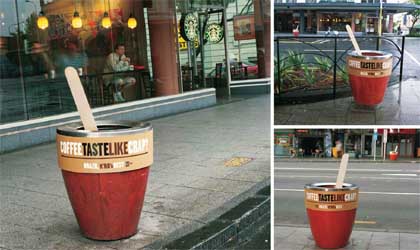
Monday, October 16, 2006
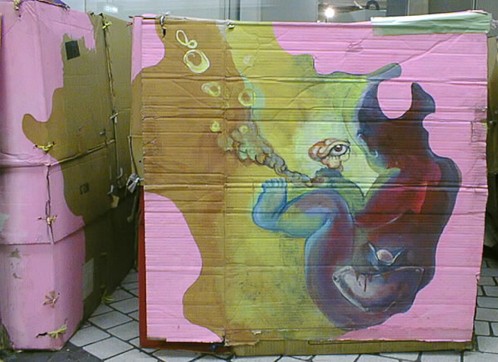
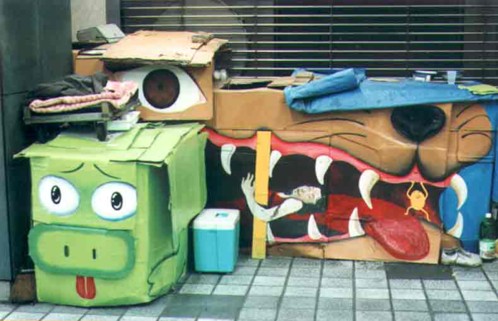
Corrugated cardboard house painting
Corrugated cardboard house painting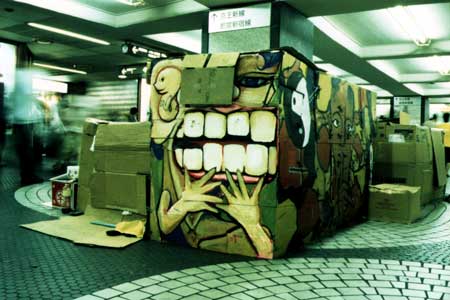
These photos show painted cardboard shelters in the homeless city that took root in the underground sprawl of Shinjuku station’s western wing in the mid-1990s. A deadly fire swept through the community in February 1998, forcing the inhabitants out and conveniently allowing the city to proceed with long-awaited plans to construct the moving walkway that now exists there. The paintings were also lost in the fire.
The cardboard house painters were Junichiro Take, who once spent 22 days in jail for performing his art in Shinjuku station, along with Takeo Yoshizaki, Yasuhiro Yamane, Itohisa Takano and others. Check out the full gallery here and read more background information here.


See more photos at Eyedia’s gallery of Shinjuku cardboard house paintings.
[Via: No-sword]
Wednesday, October 11, 2006
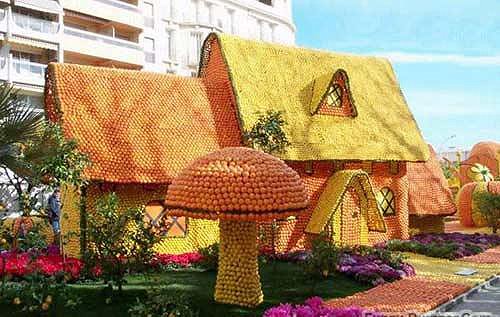
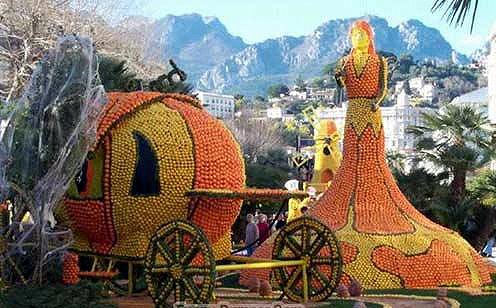
Sculptures made from oranges
Amazing art made from oranges
Most of us are fruit lovers. Creating gigantic art pieces with fruits, how about that? These sculptures are made from oranges. Click on the following links to see more.