
Red Nose Studio Art









Wednesday, February 22, 2006
Tuesday, February 21, 2006
The Power Plate
The Power Plate.
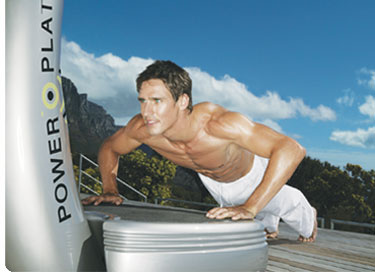
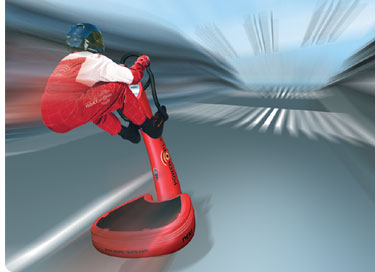
The Power Plate is apparently the hottest thing to hit the ‘get fit, get skinny’ brigade since the invention of low fat celery. You stand or squat on the thing and it jiggles your important little bits to strengthen, tone and build up muscles. Cost yer £2,599.00 for the privilege, but it must be tax deductible somehow, shirley?
The special vibrating platform stretches the muscles, which activate Tonic Vibration Reflexes. Because the Power-Plate vibrates at 30 to 50 times per second, these involuntary muscle contractions happen at the same speed. Power-Plate activates 95 to 97% of the muscle fibers Not only will your muscles contract and relax at very high speed, but also the amount of muscle fibres in every single muscle involved exceeds the amount of muscle tissue utilised in regular training. For most people in conventional training a maximum of 40% of the muscle fibres per muscle are recruited.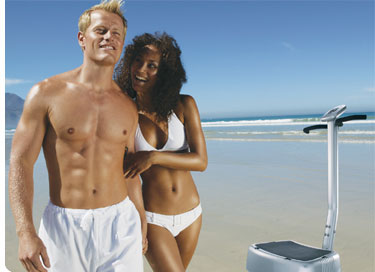



Friday, February 17, 2006
Bling your ting!
Bling your ting!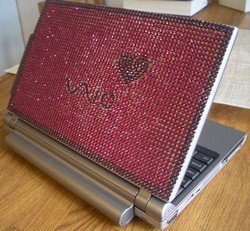

The Bling Ring Couture Kit. Why let the Hiltons have all the fun, when you can do it yourself with a genuine ‘celebrity’ Swarovski crystal kit? Goodness knows what 750 sharp pointy bits do to your silk lined pocket, let alone your street cred, but it’s your call. $125.00. Drop off VIP service also available.
For our premiere customers, we offer an exclusive VIP phone service. We will bling your phone for you! Just specify the color and design and we’ll do the work. We can even add your initials to your phone to further personalize it…We can arrange a day for you to ship your phone to us, we’ll bling it in 1 day and send it back using next day delivery. You’ll have to be able to live without your phone for 3 days, but it will come back fabulous and bejeweled!
Wednesday, February 15, 2006
The Flying Luxury Hotel
 John MacNeill
Even though the Aeroscraft dwarfs the largest commercial airliners, it requires less net space on the ground than any plane because it doesn't need a runway. The airship takes off and lands like a helicopter: straight up and down.
The Flying Luxury Hotel
Tomorrow's cruise ship will sail through the air, not the water
This is not a Blimp. It's a sort of flying Queen Mary 2 that could change the way you think about air travel. It's the Aeroscraft, and when it's completed, it will ferry pampered passengers across continents and oceans as they stroll leisurely about the one-acre cabin or relax in their well-appointed staterooms.
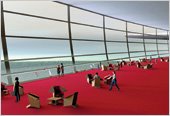
LIFTOFF!On a pressurized plane,
windows like these would explode outward .
The Aeroscraft does not fly high enough to
need pressurization.
Unlike its dirigible ancestors, the Aeroscraft is not lighter than air. Its 14 million cubic feet of helium hoist only two thirds of the craft's weight. The rigid and surprisingly aerodynamic body—driven by huge rearward propellers—generates enough additional lift to keep the behemoth and its 400-ton payload aloft while cruising. During takeoff and landing, six turbofan jet engines push the ship up or ease its descent.
This two-football-fields-long concept airship is the brainchild of Igor Pasternak, whose privately-funded California firm, Worldwide Aeros Corporation, is in the early stages of developing a prototype and expects to have one completed by 2010. Pasternak says several cruise ship companies have expressed interest in the project, and for good reason: The craft would have a range of several thousand miles and, with an estimated top speed of 174 mph, could traverse the continental U.S. in about 18 hours. During the flight, passengers would peer at national landmarks just 8,000 feet below or, if they weren't captivated by the view, the cavernous interior would easily accommodate such amenities as luxury staterooms, restaurants, even a casino.
To minimize noise, the aft-mounted propellers will be electric, powered by a renewable source such as hydrogen fuel cells. A sophisticated buoyancy-management system will serve the same purpose as trim on an airplane, allowing for precise adjustments in flight dynamics to compensate for outside conditions and passenger movement. The automated system will draw outside air into compartments throughout the ship and compress it to manage onboard weight.
The company envisions a cargo-carrying version that could deliver a store's worth of merchandise from a centralized distribution center straight to a Wal-Mart parking lot or, because the helium-filled craft will float, a year's worth of supplies to an offshore oil rig. "You can land on the snow, you can land on the water," Pasternak says. "It's a new vision of what can be done in the air."
Aeroscraft
Unlike its dirigible ancestors, the Aeroscraft is not lighter than air. Its 14 million cubic feet of helium hoist only two thirds of the craft's weight. The rigid and surprisingly aerodynamic body—driven by huge rearward propellers—generates enough additional lift to keep the behemoth and its 400-ton payload aloft while cruising. During takeoff and landing, six turbofan jet engines push the ship up or ease its descent.
This two-football-fields-long concept airship is the brainchild of Igor Pasternak, whose privately-funded California firm, Worldwide Aeros Corporation, is in the early stages of developing a prototype and expects to have one completed by 2010. Pasternak says several cruise ship companies have expressed interest in the project, and for good reason: The craft would have a range of several thousand miles and, with an estimated top speed of 174 mph, could traverse the continental U.S. in about 18 hours. During the flight, passengers would peer at national landmarks just 8,000 feet below or, if they weren't captivated by the view, the cavernous interior would easily accommodate such amenities as luxury staterooms, restaurants, even a casino.
To minimize noise, the aft-mounted propellers will be electric, powered by a renewable source such as hydrogen fuel cells. A sophisticated buoyancy-management system will serve the same purpose as trim on an airplane, allowing for precise adjustments in flight dynamics to compensate for outside conditions and passenger movement. The automated system will draw outside air into compartments throughout the ship and compress it to manage onboard weight.
The company envisions a cargo-carrying version that could deliver a store's worth of merchandise from a centralized distribution center straight to a Wal-Mart parking lot or, because the helium-filled craft will float, a year's worth of supplies to an offshore oil rig. "You can land on the snow, you can land on the water," Pasternak says. "It's a new vision of what can be done in the air."
Aeroscraft
Purpose: Long-range travel for passengers who are more concerned with the journey than the destination
Dimensions (feet): 165 h x 244 w x 647 l
Max Speed: 174 mph
Range: 6,000 miles
Capacity: 250 passengers
Tuesday, February 14, 2006
The Bust Doctor.
The Bust Doctor.
The Bust Doctor. Apparently it is some sort of shaping aid. Don’t ask us, we’re nerds.
How to use. Firstly, spray special healthful liguid on bust. After put on bust doctor, plug in and trun on switch button. You can adjust vibration power by button. 15 minutes per day is efficient to make good shaping bust.
FOB Korea: US$35/pcs
MOQ:1000pcs
Delivery: 30daysPayment: T/T in advance or L/C
Specs
*Model : Bust Doctor
*Size : 95cm × 13cm × 6cm
*Color : Silver
*Power: DC9V 500mA
*Electricity : 20W
How to use
Firstly, spray special healthful liguid on bust.After put on bust doctor, plug in and trun on switch button.You can adjust vibration power by button.15 minutes per day is efficient to make good shaping bust.
Wednesday, February 08, 2006
WebServUSB is the World’s Smallest Web Server on a USB Flash Drive
WebServUSB is the World’s Smallest Web Server on a USB Flash Drive
Truly incredible. I am speechless. And at $89 - $399, this one is worth a try. From the Website: WebServUSB is a full featured web server programmed into flash memory a USB device. It features HTTP and FTP web services, plus a companion email server program which provides POP3 and SMTP mail services. By plugging WebServUSB into any PC with a USB port, it can enable that PC to become and Intranet (LAN) or Internet based web server. WebServUSB can provide the majority of features of a web server costing thousands of dollars all embedded in the USB flash memory. WebServUSB comes in sizes ranging from 128 megabytes to 1 gigabyte.
WebServUSB’s portability makes it easy to move to any PC with a USB port and Intranet/Internet connection. All of the functions, content, and programming remain in the USB plug and will transfer to whatever PC it is plugged into. For portable Internet operation, a Dynamic DNS service such as www.no-ip.com can be used to allow WebServUSB to have a portable domain name reachable at whatever PC its plugged into. The rugged aluminum case protect it against static discharge, cosmic rays (known to erase flash memory), dust, dirt, and mechanical shock.
WebServUSB can serve one web site or even hundreds! Plus its user database allows both single user and group management of user accounts for HTTP and FTP services. For added security, the user accounts created in WebServUSB have no connection to the user accounts in the Windows based PC which its plugged into via a USB port. Thus even if an account is compromised, the intruder can go no further than the internal structure of WebServUSB! Hackers are left “dangling” out on the USB port with no access to the operating system!
WebServUSB features operational compatibility with almost all types of web content, including server side interactive CGI scripts, Perl, PHP, and a variety of multimedia formats such as Flash, RealMedia, and Windows Media. Essentially it can serve any web content.
WebServUSB is also a very handy tool for anyone who wants to learn how to set up a web server or develop websites beyond just the design stage. It allows you to see how your site will work on the web and includes several functions which permit site enhancements. As a local in-house server for debugging websites, it’s very useful and easy to manage. WebServUSB is also superb for carrying on the road, for use with a Laptop. It provides a great way to setup Intranet or Internet file sharing or distribution for projects where you may need to share documents with many people, such as for training.
WebServUSB is simple to configure. This tutorial is written from the point of view of a complete novice and includes step-by-step instructions to set up the basic server plus an example of how to include an additional function (in this case a PERL based message board). Since WebServUSB is compliant with most standards applied to high end web servers, almost any web server add-on or program will function with it.
More Info Here
Source: WebServUSB.com
Tuesday, February 07, 2006
Selk'bag
Selk'bag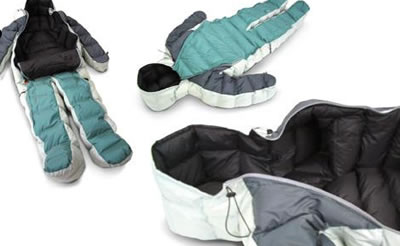
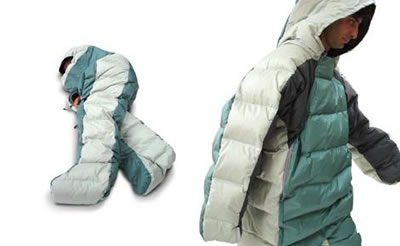
Where the f*ck was this when we were in cold ass Utah for the Sundance Film Festival. This thing looks so comfortable, I wouldn't have minded one bit sleeping on the floor.
It's called the Selk'bag - a sleeping bag system which looks like a giant full body uni-garment. Inside or outdoors, the Selk'bag gives the body maximum mobility and comfort. Fully lined and insulated but not bullky. Stand without any trouble, walk, cross your arms and legs, and when you get tired, just roll over and sleep.
Please BUY us both one!
more pictures after the jump

Sunday, February 05, 2006
Future Phone
Future Phone
Flash Movie Here
Imagine the device that unites everything that you carry along: a mobile phone, a player, your credit and discount cards, your apartment and your car keys. We have imagined it and now introduce you to the future.The device in size of a credit card 54x85,6 mm (C'ALL) will replace all those. Moreover it can work as: - Video phone. Before making a call you can choose an operator of a mobile communication. - All credit and discount cards that you have. The built in program will prompt an optimum variant for discounts at the given payment place. - The remote control for any device. It can simultaneously display a teleschedule and recommendations of your favourite site. - Keys from doors of houses and cars you have an authorization to. - GPS-system that can automatically upload aerial photos from the Internet. - Library, video- and music shop. You can read, listen to and whatch all that at your choise. Go to a public online library or buy all that you want in any shop of the world. - Gaming device with support of network gaming (remember that you have a GPS and the virtual reality becomes quite real). - Even your computer that works with any operational system that is beeng uploaded through the Internet. For any actions connected with safety (payment, opening of a door, ...) the device authorizes you by reading your fingerprints. All trademarks and registered trademarks are the property of their respective owners.

Download press materials (*.zip, 11.8 Mb)
Tuesday, January 31, 2006
The Pee Tree
The Pee Tree
Some men avoid going to the public toilets due to the smelly atmosphere and, unable to find a wildlife tree, they go for street corners or the facade of your favourite bar.
So Joa Herrenknecht has designed the Pee-tree urinal for public spaces. His bright ceramic white colour is a strong signal that can be seen from far – making it accessible when in urgent need. The trunk offers a perfect place for messaging, e.g. "I was here" or "done that" statements. The urine is directly flushed down to the underground sewage canal.Part of the The PeePee project by HFG.
See also Eric Morel's Pee Tree (via ReLuct)T
his post is dedicated to l'Ingeniere.
Via Designboom.
Gallery:


Sunday, January 29, 2006
Asahi’s Beer Pouring Robots
Asahi’s Beer Pouring Robots
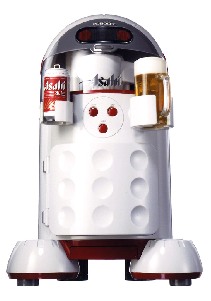
By David Ponce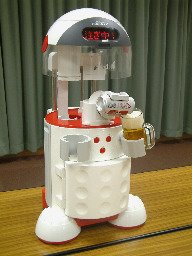 Here’s a match made in heaven: beer and robots. For most of the world, it’s a match we are left to simply dream of (you know, slave bots bringing you a cold one, instead of the usual “Get it yourself!”) If you live in Japan however, you should know that Asahi is running a promotion where they’ll be giving away 5,000 fully stocked refrigerator robots. What do these lovely creatures do?
Well, aside from stocking and cooling up to six cans of beer and two mugs, upon the press of a button, the machine will open up a can, and pour in into the mug with a perfect head every time.
To win one, contestants must collect 36 seals found on specially marked Asahi beers. Of course, you don’t have to drink the beer… but then you’d probably be missing the point.
[Robot-Dreams] VIA [Prylfeber]
Come inside for a few more pictures.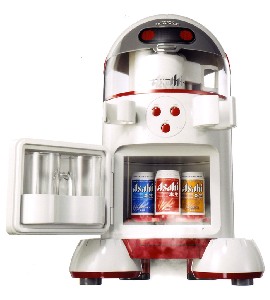

Tuesday, January 24, 2006
U.S. Army To Test Super Gun
U.S. Army To Test Super Gun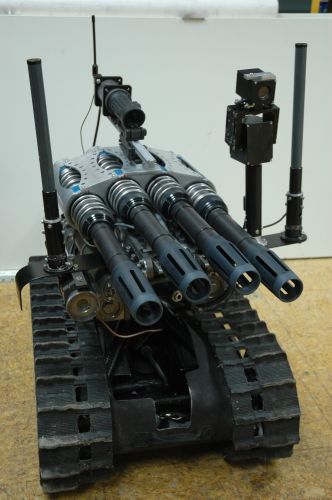
The U.S. Army plans to test next month a SUPER GUN from a company appropriately called Metal Storm that can shoot 240,000 bullets per minute. The gun has no moving parts. Among its many tricks, the gun can actually shoot down enemy mortar fire. I want one.
Monday, January 23, 2006
New phone uses world's smallest disk
New phone uses world's smallest disk
Coin-sized platter holds 2,000 songs, claims Toshiba
Simon Burns, vnunet 23 Jan 2006
Toshiba has designed a mobile phone using the world's smallest disk drive, according to Japanese sources. The 2.1cm drive, also made by Toshiba, is so small that six would fit business card.
Japanese mobile phone service provider KDDI said that the W41T handset will go on sale in Japan early next month.
The operator is positioning the phone primarily as a music player, and the launch will tie in with the start of KDDI's new music download service due in April.
The 157g W41T also features Bluetooth wireless connectivity, a 3.2-megapixel camera, a 2.4in 240 x 320 pixel LCD screen, and an FM radio. KDDI has not revealed a price for the product.
Toshiba has not announced any plans to sell the W41T, which works on CDMA networks, outside Japan.
Elsewhere, Imation is selling the 2.1cm Toshiba drive as a standalone product with a USB interface at a street price of around $180. According to Imation, the 3,600 RPM drive has a maximum read speed of 5Mbps.
Nokia's forthcoming N91 phone will also use a 2.1cm 4MB drive, according to a Nikkei Business Press report. The delayed N91 is expected by mid-2006, but Nokia has not yet given the product an official release date.
While the addition of disk drives to phones has raised questions about reliability, smaller drives are generally better able to cope with being dropped than their larger cousins because their moving parts have less mass.
Toshiba claims that its new drive can withstand a force of 1,000G while operating. This is roughly equivalent to an unprotected fall onto a hard surface from a height of one metre.
The manufacturer has said that its storage device division plans to develop a 2.1cm drive with a capacity of 10GB in future by using perpendicular recording technology to pack more data onto the disk.
Currently, the company's 2.1cm disk faces competition from similarly-priced 4GB flash memory products, and from larger 4GB compact flash format hard drives at approximately half the price.
Thursday, January 19, 2006
Turn and old scanner into a 115 megapixel camera (sample photos)
Turn and old scanner into a 115 megapixel camera (sample photos)
Building homemade digital cameras from low-end flatbed scanners.
Making new kinds of cameras to see the world in a new way...
Several years ago, I built my first homemade digital camera. The idea was simple - I would take an ordinary flatbed scanner, and use it in place of photo paper with a large format camera.
My first scanner camera was made from lots of duct tape, a cardboard box, and the cheapest flatbed scanner that I could find. I expected this to be a quick little art project, one that would take a week or two at the most. But when I got my first homemade digital camera to work, I noticed that some wonderful things were beginning to happen.
The objects in the scene that were stationary photographed normally, while the objects that were moving were twisted and distorted into wonderful shapes. At first, I thought that this was a mistake, that something was wrong with my new contraption. But I soon realized that the motion of the scanner was meshing with the motion of the recorded scene, creating unexpected, yet predictable, results. These motion distortions are similar to the effect created by moving a sheet on a photocopier mid-copy, except that they extend into three dimensions and only effect objects in motion.
I was tremendously excited by these developments. Instead of building a camera that mimicked the functionality of a traditional photographic camera, I had stumbled across a new tool for examining the relationships between time, motion, and image. What I though would be a two week art project has turned into one that has lasted for almost three years, and shows little sign of stopping. My cameras work a lot better now, although most of them still use a lot of duct tape, cardboard, and cheap flatbed scanners. I've begun to learn the vocabulary of the scanner camera, begun to be able to interpret and previsualize these strange new pictures. Some aspects of scanner photography are similar to traditional photography, and others are completely foreign.
Thanks for looking at my work... I hope you like it!
Mike Golembewski
P.S. Here's a little information about these photographs. The only software based manipulation of any of these images has been some slight adjustments of the curves and levels, in order to improve contrast and tone for print and screen display. They haven't been 'Photoshopped' in order to create these effects. All of the motion distortions are created entirely in camera.
© 2002-06 Michael Golembewski. Sponsored by the Audi Design Foundation, 2004-05. email
Most recent scanner camera...
The scanner camera that I'm using right now uses the frame of an old Horseman 450L monorail 4x5 camera, which I purchased secondhand with the support of the Audi Design Foundation. The scanning back is an extensively modified Canon LIDE 20, from which I have reomved the lamp, pinhole lens assembly, and CIS sensor housing. I've made the scanner light-tight using duct tape and putty, covered with a hefty dose of black spraypaint. It might look crude, but it works very nicely. I've attached a modified lens board directly onto the scanner, so it can easily be connected to the Horseman. The lens board attachment holds the scanner optics at the same level as a ground glass plate. This allows me to compose and focus shots on the ground glass, instead of with preview scans - it's much faster. I have two lenses that I use with this model - a Kompur lens from 1915, and a found 8x10 enlarger lens.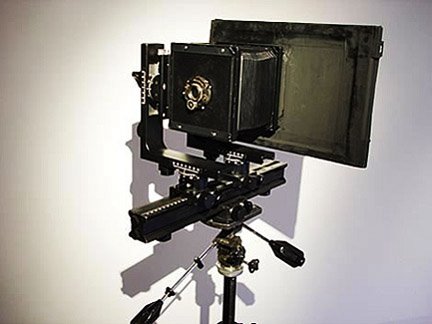
Here are a few technical specifications for this camera... I'll add a few more later on (once I get around to gathering the data...)
Maximum resolution:115,200,000 pixels per image (over 115 megapixels).
Scanning speed: 15 seconds to five minutes scan time, depending on resolution.
© 2002-06 Michael Golembewski. Sponsored by the Audi Design Foundation, 2004-05. email
Tuesday, January 17, 2006
Hasselblad Introduces its New 39 Megapixel H2D-39 Digital Camera
Hasselblad Introduces its New 39 Megapixel H2D-39 Digital Camera
Hasselblad's new H2D-39 D-SLR is the first true 39 megapixel digital camera in the world. It is based on Hasselblad's existing H2 digital camera and is compatible with the company's H System lenses and V camera lenses.
The camera's CCD sensor is more than twice the size of conventional 35mm camera sensors (36.7 x 49.0 mm). At maximum resolution, the images captured by the H2D-39 in Hasselblad's proprietary 3F RAW format are 78MB large (50MB with lossless compression).The camera features a 2.2? OLED display, a FireWire 800 interface, support for CF media and an optional Image Bank 80GB external hard drive. The H2D-39 is also expandable thanks to its i-Adapter interchangeable camera interface. The CF-39, CF-39MS and CFH-39 digital-back modules allow the user to tailor the camera to his or her shooting parameters. Also featured is the company's digital APO correction (DAC) which diminishes the effects of color abberations and provides a fuller, more life-like picture. The camera captures images in 16-bit formats and supports ISO ranges 50, 100, 200 and 400. More details can be found HERE Preliminary pricing for the different digital-backs are as follows (in US dollars): H2D-39 - $ 32,000 CF-39 - $ 33,000 CFH-39 - $ 33,000 CF-39MS - $ 40,000
Source : dailytech.com
Subscribe to:
Posts (Atom)


